
چکیده مقاله
Urban areas worldwide face escalating challenges in managing surface water and floods, a predicament exacerbated by rapid urbanization and climate change Tehran, the dynamic metropolis of Iran, uniquely contends with topographical intricacies and swift urban development This article explores the transformative role of Artificial Intelligence AI in addressing surface water and flood risks in Tehran In Tehran, complex topography and rapid urban expansion amplify vulnerabilities in flood management Inadequate drainage infrastructure and the prevalence of impermeable surfaces heighten the city's susceptibility to flooding To counter these challenges, innovative solutions leveraging AI technologies are imperative AI emerges as a powerful tool in revolutionizing flood management in Tehran Early Warning Systems, powered by AI algorithms, enable real time data analysis, flood prediction, and timely alerts The scope of AI extends to real time monitoring, predictive modeling, and infrastructure optimization, collectively bolstering Tehran's resilience to floods The city's unique topography and climate necessitate customized AI solutions Machine learning algorithms, fine tuned with local data, create precise predictive models tailored to Tehran's distinct conditions Informed by AI insights, smart urban planning optimizes resource allocation for infrastructure development, enhancing the city's overall flood resilience A comprehensive case study evaluates the practicalimplementation of AI in Tehran's flood management The study delves into the effectiveness of AI driven early warning systems, real time monitoring, and predictive modeling, providing valuable insights into their impact on mitigating flood risks While AI holds promise, challenges such as data accuracy, model interpretability, and publicacceptance demand ongoing scrutiny Continuous research, stakeholder collaboration, and a commitment to adaptive strategies are pivotal for sustaining the success of AI driven flood management in Tehran In conclusion, the integration of Artificial Intelligence signifies a paradigm shift in Tehran's approach to surface water and floodmanagement The case study exemplifies the tangible benefits of AI technologies, showcasing their potential to reshape flood management strategies in complex urban environments As Tehran evolves, embracing AI becomes indispensable for crafting a city capable of adeptly navigating the evolving challenges of water management in the21st century
کلیدواژهها
نویسندگان

Seyed Reza Samaei
Post doctoral, Lecturer of Technical and Engineering Faculty, Science and Research Branch, Islamic Azad University, Tehran, Iran
Madjid Ghodsi Hassanabad
Associate Professor, Department of Marine industries, Science and Research Branch, Islamic Azad University, Tehran, Iran
شیوه ارجاع
Samaei, Seyed Reza and Ghodsi Hassanabad, Madjid,1402,Management of Surface and Flood Water Collection in Tehran Metropolis Using Artificial Intelligence,The second international conference on creative achievements of architecture, urban planning, civil engineering and environment in the sustainable development of the Middle East,Mashhad
ارائهشده در
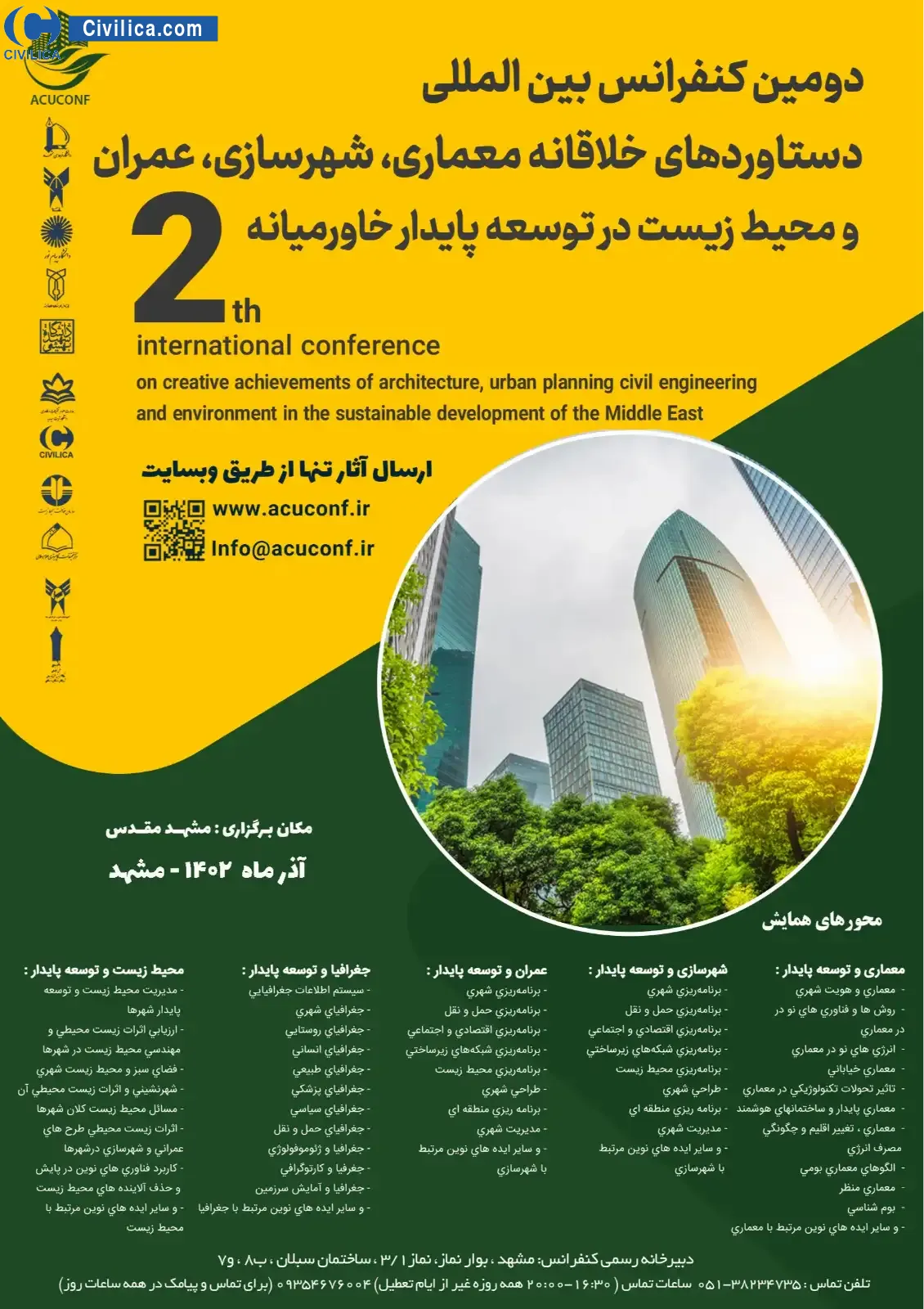 مجموعه مقالات دومین کنفرانس بین المللی دستاوردهای خلاقانه معماری، شهرسازی، عمران و محیط زیست در توسعه پایدار خاورمیانه10 آذر 1402 · مشهد