
چکیده مقاله
The integration of lightweight concrete into smart city infrastructure presents a compellingopportunity to enhance sustainability, resilience, and efficiency This study explores the impact oflightweight concrete utilization in smart cities, drawing upon empirical evidence, theoreticalframeworks, and data analysis to provide a comprehensive understanding of its implications Theoreticalframeworks, including Life Cycle Assessment LCA and Actor Network Theory ANT , offer valuableinsights into the environmental and sociotechnical aspects of lightweight concrete adoption Analysis ofrelated data reveals significant energy consumption reductions of 15 20% for buildings constructed withlightweight concrete compared to traditional concrete structures Cost analysis demonstrates comparableor lower total costs over the project lifecycle, with savings of up to 120,000 attributed to lightweightconcrete materials, labor, and transportation Integration into smart city infrastructure involvessustainability assessment, structural endurance testing, and performance criteria evaluation Sustainability indicators show lightweight concrete outperforming traditional concrete in CO2emissions reduction 25% , energy consumption 20% , and resource efficiency 80% Structuralendurance tests confirm superior performance in seismic resistance, freeze thaw durability, and fireresistance Performance criteria specifications ensure structural integrity >95% , thermal insulation RValue>20 , fire resistance UL Class A , and construction efficiency
کلیدواژهها
نویسندگان

Iman Ebrahimi
Ph D student, Department of Marine industries, Science and Research Branch, Islamic AzadUniversity, Tehran, Iran
Behnaz Gholamzadeh.
Master's degree, Architecture, Faculty of Architecture, Abadan branch of Islamic AzadUniversity, Abadan, Iran
شیوه ارجاع
Ebrahimi, Iman and Gholamzadeh., Behnaz,1403,Advancing Smart Cities through LightweightConcrete: A Comprehensive Examination ofSustainability, Resilience, Efficiency, and Innovation,Second International Conference on applied researches in civil engineering, architecture and urban planning
ارائهشده در
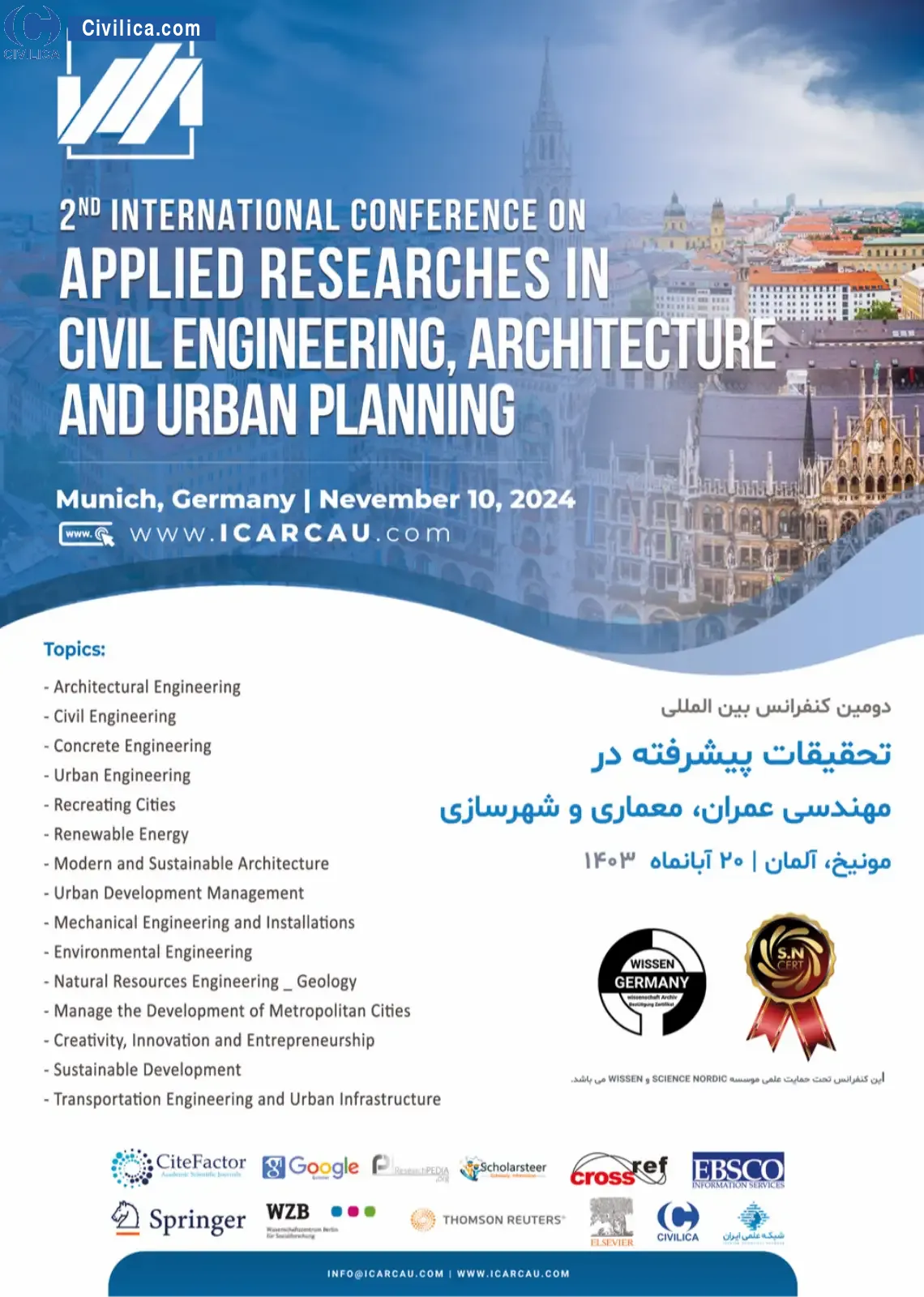 مجموعه مقالات دومین کنفرانس بین المللی تحقیقات پیشرفته در مهندسی عمران، معماری و شهرسازی20 آبان 1403