
چکیده مقاله
The present study aims to compare the effect of backward teaching and passive teaching methods on learning the seventh grade experimental science course junior high school The research method is quasi experimental with a pretest posttest design This study's statistical population is all seventh grade female students of Kaj's first secondary school, Pasdaran Effat Girls' High School, which has four classes with a total of 128 pupils in the years 2021 22 The one step cluster random approach was used for sampling In the course of the experimental science, a statistical sample size of two seventh grade classes was investigated after balancing the topics, one in the form of passive learning with 30 people and the other in the form of backward education with 32 people The learning rate of the groups was measured using an academic achievement exam Teachers, professionals, and educational specialists' opinions were utilized to assess the questionnaire's content validity The statistical data of the hypotheses were analyzed using an analysis of covariance The findings of the test analysis revealed that in both the experimental and control groups, there was a significant difference in the scores of simple in depth and simple superficial learning In other words, the backward teaching approach is more successful than the passive teaching method in enhancing pupils' general, deep, and atomic superficial learning Keywords: Backward education, Passive teaching method, In depth lasting and atomistic superficial learning, Experimental sciences
نویسندگان

Hossein Hajati Kaji
Master of Curriculum Planning, Allameh Tabatabaei University, Tehran
Zeinab Hajati
Bachelor of Educational Sciences; Farhangian Nasibeh University of Tehran
شیوه ارجاع
Hajati Kaji, Hossein and Hajati, Zeinab,1401,Comparing the Effect of Backward Education and Passive Teaching Methods on Learning Experimental Science Course of Seventh Grade Female High School Students,Fourth National Conference on Interdisciplinary Research in Management and Humanities,Tehran
ارائهشده در
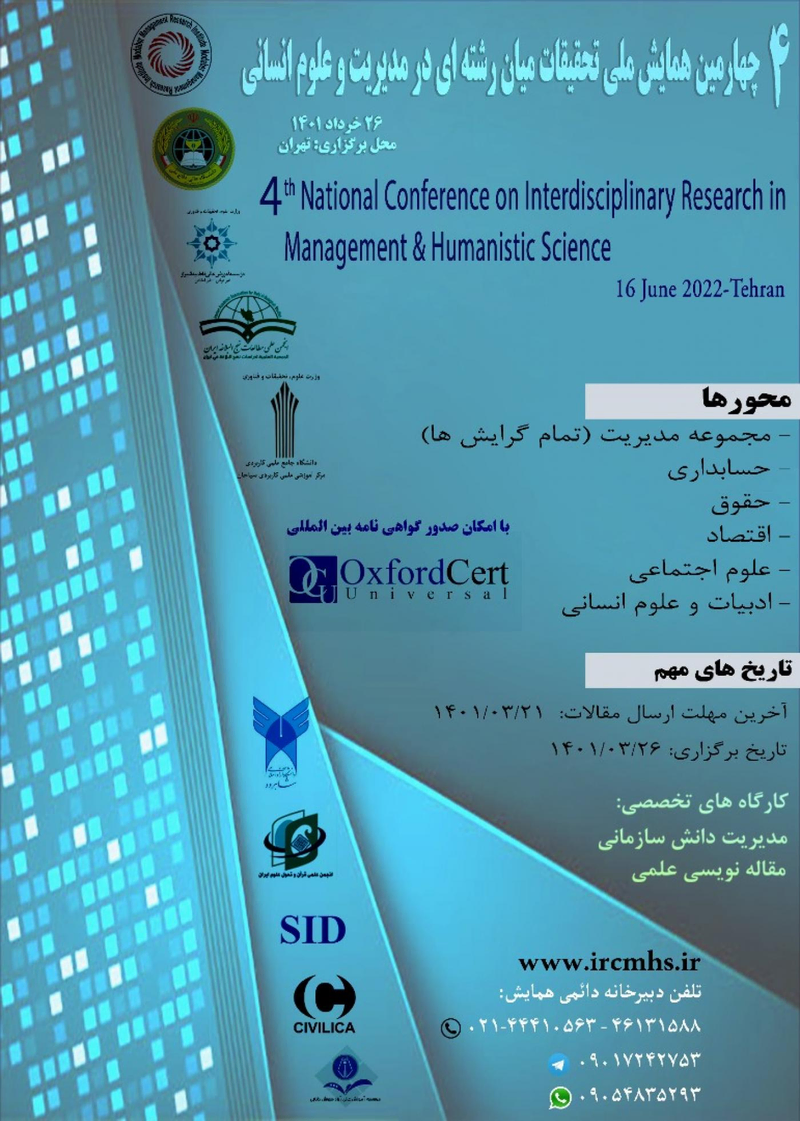 مجموعه مقالات چهارمین همایش ملی تحقیقات میان رشته ای در مدیریت و علوم انسانی26 تیر 1401 · تهران