
چکیده مقاله
The paper investigates the traditional Islamic Iranian cities and the institutions involved in urban governmentality Three institutions are recognized: the institution of the sovereign nahad e saltanati , the institution of shari’a nahad e shar’i , and the institution of custom nahad e ‘urfi corresponding respectively to the state, religion Islam , and communal affiliations Each institution conforms to a form of power which is exercised directly or indirectly by that institution These are, to borrow Foucault’s terminology, the sovereign power of the state, the disciplinary power of the religion, and the bio power of the ‘urf The main argument of this paper is that in the absence of legal codes and municipal services in the traditional Iranian cities, the religion Islam , through its disciplinary mechanism, played a fundamental role in production and maintenance of governmentality at different levels of public and private domain of urban life Urban space of traditional Islamic iranian cities was the medium through which different mechanism of power and social control took place
کلیدواژهها
نویسندگان

Hossein Maroufi
Assistant Professor in Urban Planning Department of Architecture, Planning and Islamic Art University of Mashhad Ferdowsi
شیوه ارجاع
Maroufi, Hossein,1393,Urban Governmentality in traditional Islamic-Iranian cities:the dialectic nexus between sovereignty, religion, and custom,6th National Conference on Urban Planing and Management with Emphasis on the Elements of Islamic City,Mashhad
ارائهشده در
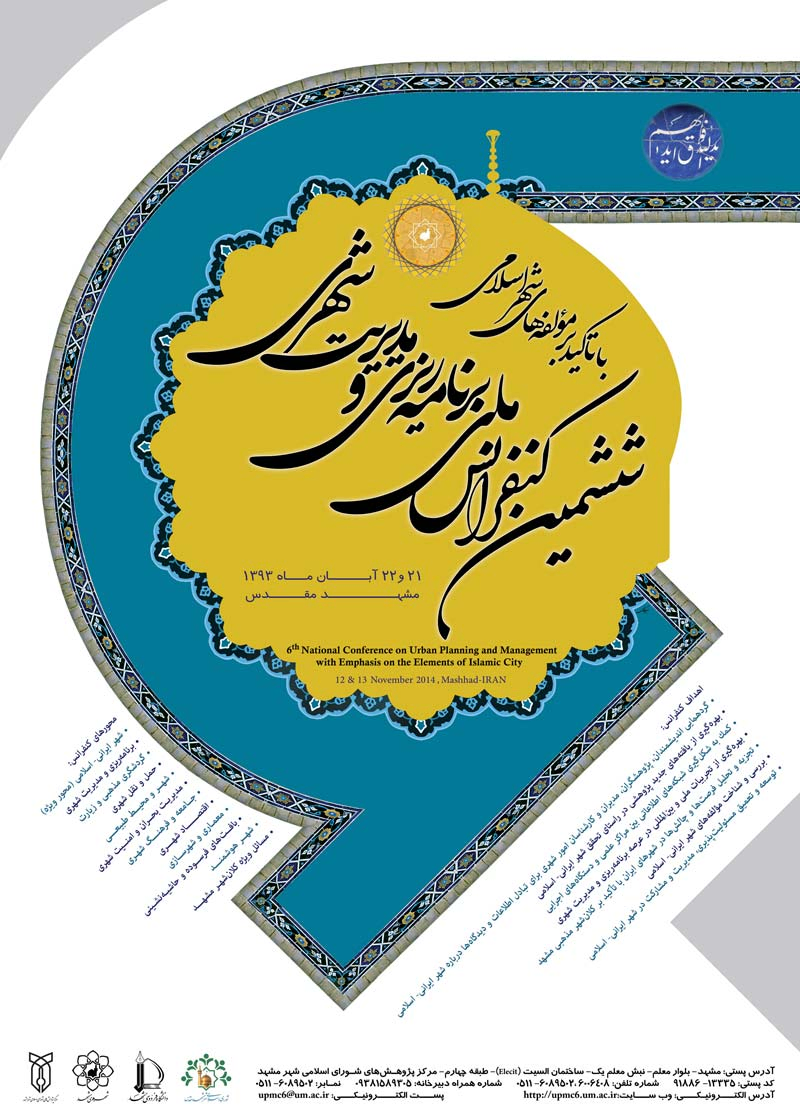 مجموعه مقالات ششمین کنفرانس ملی برنامه ریزی و مدیریت شهری با تاکید بر مولفه های شهر اسلامی21 آبان 1393 · مشهد