
چکیده مقاله
The UAE construction industry has seen double digit growth in the last two decades, stimulated by massive urban development and the need for high level architectural schemes Accompanying these successes, however, the industry still grapples with serious safety issues As an architectural engineer with proper HSE training and practical exposure on construction sites, I have witnessed how quickly the pace of work would result in safety culture taking a backseat, especially where responsibility and awareness are not established deep inside While the UAE has embraced national safety standards and aligned with international codes, building sites too frequently are marred by inconsistent enforcement, poor training of workers, and communication breakdowns between design teams and site personnel In these environments, civil engineers are no longer solely technical specialists—they are also key agents of influence on worksite culture and safety behavior This study explores how civil engineers' education and professional engagement can actively improve a safety culture in UAE construction projects Through a qualitative content analysis of formal policies, theoretical literature, and industry case studies, the research discovers the means through which civil engineers help avert accidents—from design coordination and risk assessment to team management and ethics decision making By placing focus on their contribution above structural responsibility, this research brings to the fore the engineer's potential to act as a cultural leader in reducing risk and enhancing long term safety culture practices across the industry
کلیدواژهها
نویسندگان

Radmehr Bagheri
Master’s Student of Architectural Engineering, Islamic Azad University, UAE Branch;
Farshad Karazmay
Department of Civil Engineering, Faculty of Engineering, University of Bonab, Bonab ۵۵۵۱۳۹۵۱۳۳, Iran
شیوه ارجاع
Bagheri, Radmehr,1404,Engineering a Culture of Safety: The Role of Civil Engineers in Preventing Accidents in Construction Projects in the United Arab Emirates,18th International Conference on Mechanical, Construction Industrial & Civil Engineering
ارائهشده در
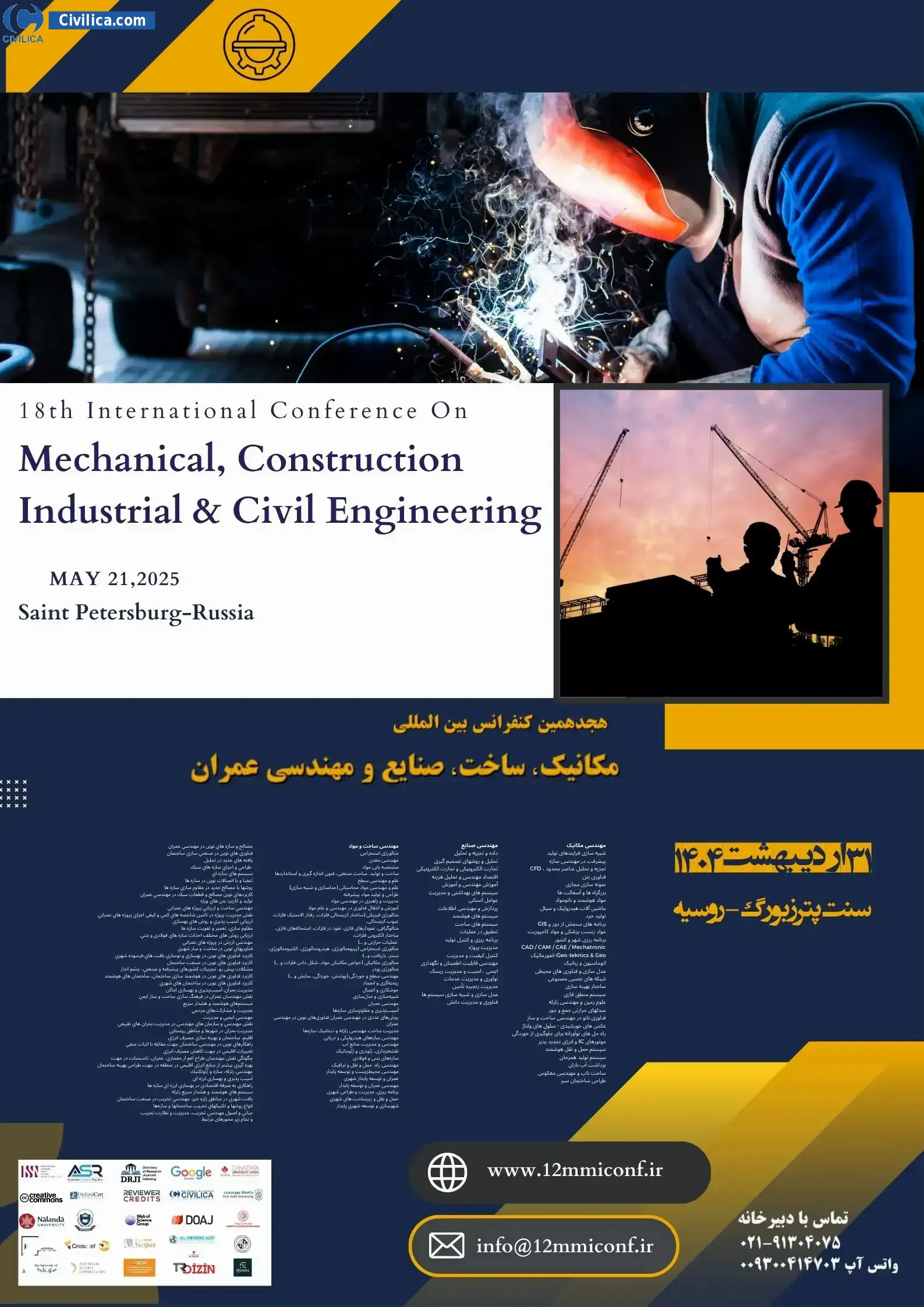 مجموعه مقالات هجدهمین کنفرانس بین المللی مکانیک، ساخت، صنایع و مهندسی عمران31 اردیبهشت 1404