
چکیده مقاله
With growing global warming and depletion of natural resources, there is an increased emphasis on environmental preservation and reducing negative impacts in all sectors Life Cycle Assessment LCA has emerged as an effective method to evaluate the environmental impacts of products and services, considering all life stages from raw material extraction to final disposal The primary goal of LCA is to support informed and sustainable decision making in production, consumption, and waste management In this context, geosynthetics have been introduced as materials that can help protect the environment Owing to their unique properties, geosynthetics are used in applications such as stabilizing soil systems, improving engineering performance, and reducing environmental impacts This paper is a review study examining previous research on LCA of geosynthetics compared to traditional materials in civil engineering projects The findings reveal that incorporating geosynthetics in civil engineering applications can reduce environmental impacts by approximately 40–80% across major indicators such as global warming potential, acidification, eutrophication, photochemical ozone creation, and cumulative energy demand, depending on the specific application and boundary conditions Moreover, by shortening construction time and reducing costs, geosynthetics offer not only environmental advantages but also prove to be cost effective from an economic perspective
کلیدواژهها
نویسندگان

Ghazal Fatemi
M Sc Student, Department of Civil and Environmental Engineering, Amirkabir University of Technology, Tehran, Iran
Taghi Ebadi
Associate Professor, Department of Civil and Environmental Engineering, Amirkabir University of Technology, Tehran, Iran
Ghorbanali Dezvareh
Assistant Professor, Department of Civil Engineering, Mehr Alborz University, Tehran, Iran
شیوه ارجاع
Fatemi, Ghazal and Ebadi, Taghi and Dezvareh, Ghorbanali,1404,Life Cycle Assessment of Geosynthetics versus Traditional Materials: A Review of Case Studies in Civil Engineering Projects,The 3rd National Conference on Environmental Challenges: The role of industry, mining, and society in developing green governance,Tehran
ارائهشده در
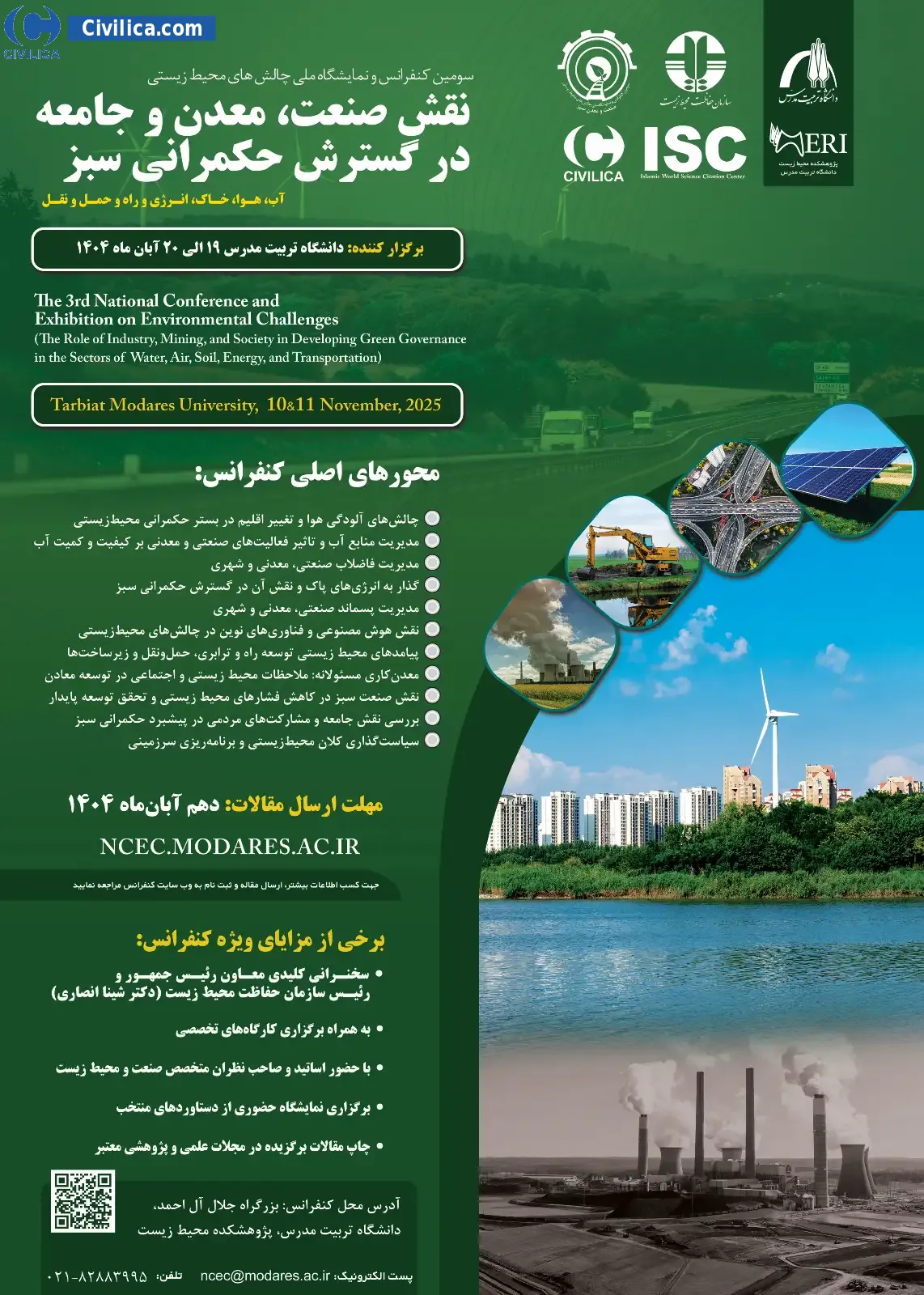 مجموعه مقالات سومین کنفرانس و نمایشگاه ملی چالش های محیط زیستی: نقش صنعت، معدن و جامعه در گسترش حکمرانی سبز19 آبان 1404 · تهران