
چکیده مقاله
Background: Approximately one third of pregnancies in Iran are unplanned The way individuals confront and resolve unintended pregnancies is shaped by prevailing social conditions and cultural values, many of which are transmitted to couples through family structures Responses to unplanned pregnancy can significantly affect the health of the mother, child, family, and even society This qualitative study aimed to explore the role of families in women's experiences of unplanned pregnancy and in the decision to continue or terminate the pregnancy Methods: This study was conducted in Isfahan, Iran, in 2024 2025 using qualitative content analysis Participants included women with experiences of unplanned pregnancy, their husbands, and family members, recruited through purposive sampling with maximum variation until data saturation was achieved Data were collected through in depth, semi structured individual interviews and field notes Transcripts were analyzed using conventional content analysis; significant statements were coded and then organized into subcategories and main categories through inductive classification Results: A total of 20 women with experiences of unplanned pregnancy, 8 husbands, and 8 key family members participated in the study From the interview analysis, 1,011 codes were extracted and inductively classified into 15 subcategories, 6 secondary categories, and 2 main categories Women's experiences were captured in two overarching themes: 1 the family's role in shaping the labeling of pregnancy as unplanned, and 2 the family as a peripheral yet powerful factor in determining the outcome of unplanned pregnancy Each of these themes comprised several secondary categories and subcategories Conclusion: Families play a crucial role in shaping the perception of unplanned pregnancy by influencing reasons for its undesirability, including gender preference, number of children, social pressure on couples, and the provision or lack of emotional and psychological support Key family members, particularly husbands and mothers, were identified as central figures in decision making regarding continuation or termination of pregnancy According to participants' experiences, husbands were the most significant supporters in continuing the pregnancy Therefore, it is recommended that fetal life preservation programs prioritize family engagement, with a particular focus on raising awareness and fostering the supportive role of husbands Keywords: Unplanned Pregnancy, acceptance, family, Continuity of pregnancy, Abortion
کلیدواژهها
نویسندگان

Fatemeh Mokhtari
Student Research committee, School of Nursing and Midwifery, Isfahan University of Medical Sciences, Isfahan, Iran
Shahnaz Kohan
Professor, Department of Midwifery and Reproductive Health, School of Nursing and Midwifery, Reproductive Sciences and Sexual Health Research Center, Isfahan University of Medical Sciences, Isfahan, Iran
شیوه ارجاع
Mokhtari, Fatemeh and Kohan, Shahnaz,1404,Family Influence on Experiences and Choices in Facing Unplanned Pregnancy,Preservation of Fetal Life conference,Isfahan
ارائهشده در
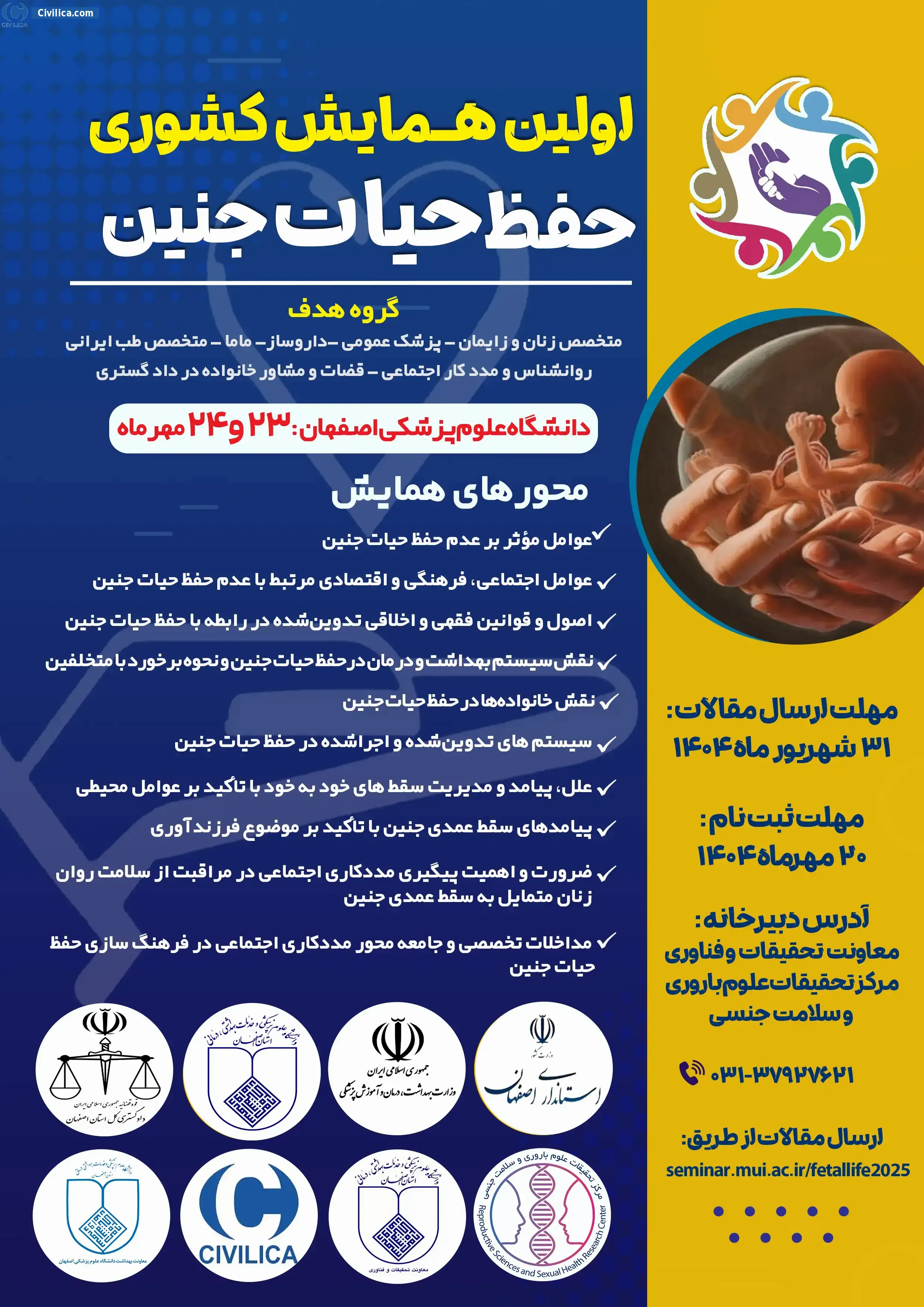 مجموعه مقالات اولین همایش کشوری حفظ حیات جنین23 مهر 1404 · اصفهان