
چکیده مقاله
Artificial intelligence applications in urban waste management integrate machine learning, deep learning, computer vision, and reinforcement learning with IoT sensors, robotics, and blockchain to enable comprehensive circular economy systems Global implementations demonstrate collection efficiency improvements up to %, sorting accuracies ranging from VY,A% to 99,90%, and operational cost reductions between 0%, with mature implementations reaching Vo% cost savings Al facilitates circular economy principles through waste reduction mechanisms, enhanced resource recovery via automated sorting, closed loop system creation through real time monitoring, and material flow optimization that diverts waste into value added products Economic frameworks reveal substantial initial capital requirements e g , USD or billion for achieving % recycling rate in Moscow offset by medium to long term returns through reduced operational costs, increased recycling revenue Y % gains , and job creation , positions documented in Moscow Critical implementation barriers include data quality issues, high upfront costs particularly challenging for resource constrained cities, insufficient policy frameworks, and low public awareness Success factors include phased deployment prioritizing high ROI applications, innovative financing mechanisms through public private partnerships, supportive regulatory frameworks, and systematic stakeholder engagement Despite these advances, no studies specifically address Tehran Municipality Only one Iranian implementation is documented in Mashhad, achieving ON% waste industry development leaving Tehran without a tailored economic framework for AI driven waste restoration This paper develops a conceptual economic framework for integrating AI into urban waste restoration, tailored specifically to Tehran Municipality's operational and budgetary context The proposed four layer model Detection & Sorting, Process Optimization, Market Linkage, Policy Feedback adapts global evidence efficiency gains of %, cost savings of 10% to Tehran's local context Feasible entry points include AI assisted drop off centers, routing optimization, and automated material classification pilots, implemented through phased deployment and public private partnerships The framework requires no primary data collection, making it immediately applicable for municipal policy planning Future research can empirically validate the framework using Tehran specific operational data
کلیدواژهها
نویسندگان

Zahra Rostami Kamal Abad
Tehran Municipality
Zahra Rostami Kamal Abad
Tehran Municipality
Eisa Rostami
Tehran Municipality
Eisa Rostami
Tehran Municipality
شیوه ارجاع
Rostami Kamal Abad, Zahra and Rostami, Eisa,1405,Artificial Intelligence in Urban Waste Restoration: A Conceptual Economic Framework for Tehran Municipality,The 17th International Conference on New Ideas in Architecture, Urban Planning, Geography and Sustainable Environment,Mashhad
ارائهشده در
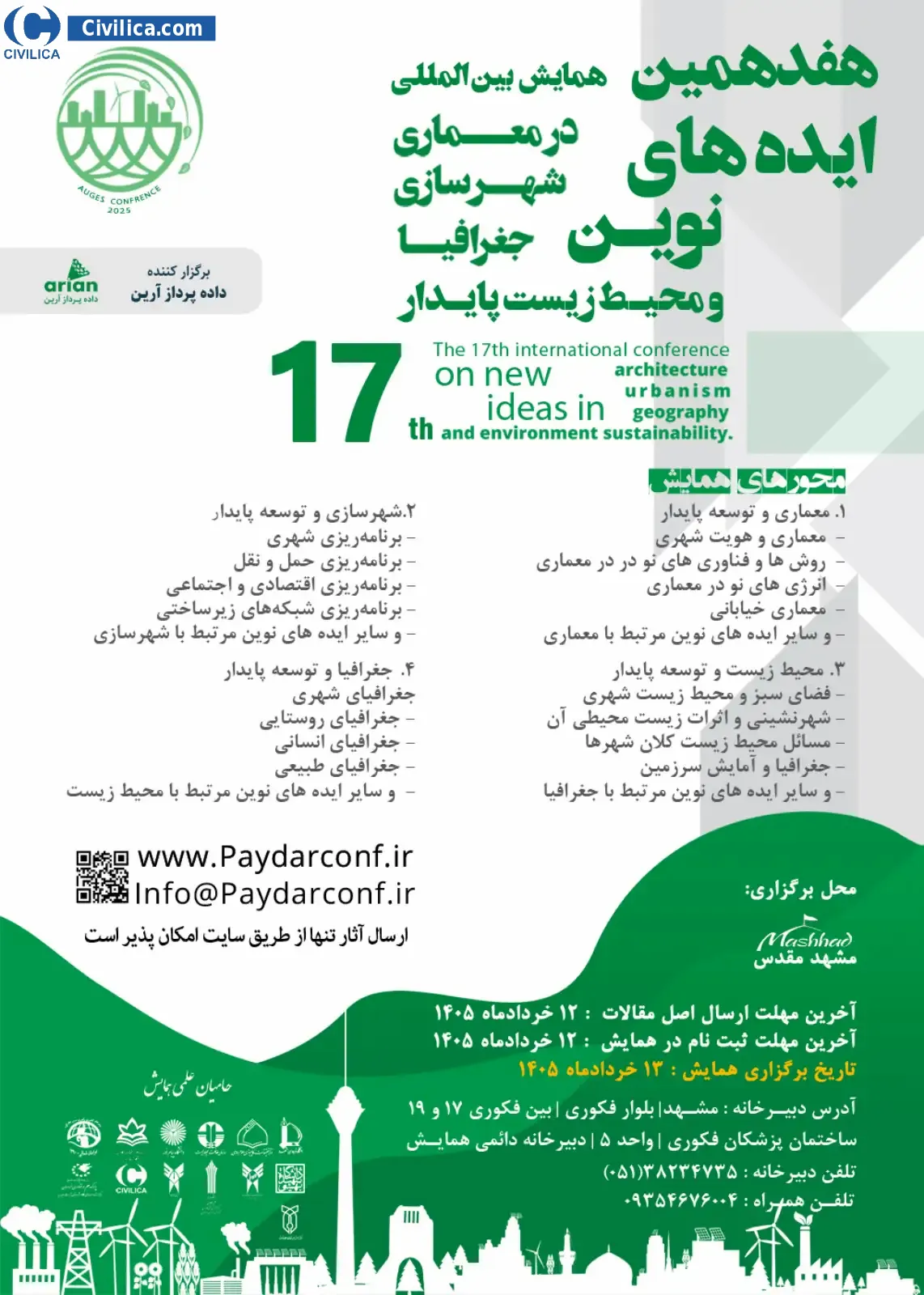 مجموعه مقالات هفدهمین همایش بین المللی ایده های نوین در معماری، شهرسازی، جغرافیا و محیط زیست پایدار13 خرداد 1405 · مشهد