
چکیده مقاله
with the advancement of communication systems, intelligent traffic systems play an important role in optimizing the traffic flow in large and densely populated cities Today, widespread broadband networks provide real time traffic data sets that intelligently optimize traffic routing With this in mind, this paper presents a model for calculating street travel time Each vehicle, upon arrival, receives the optimal route dynamically according to its source and destination The urban traffic situation is reviewed periodically and using the method of detection and prediction of congestion, streets susceptible to traffic congestion are identified and using the proposed algorithm of vehicle selection, selected vehicles are re routing using the Dijkstra algorithm and based on shortest route possible The evaluation shows that the average travel time of the proposed method compared to other research methods, such as EBKSP and FBKSP, was reduced 16% and 20% respectively, and 8% compared to AR method The results also show that the average number of rerouting in the PDDVRWF method decreased by 0 71 for each vehicle compared to 0 8 for the EBKSP and 0 85 for FBKSP method, and an increase of 0 11 was found for the AR method In the following, the average waiting time for drivers for different traffic conditions is compared In addition to routing the carsbased on the current situation, the traffic lights are dynamically adjusted The results of the performance evaluation of the proposedmethod by simulation show the performance of the proposed model in optimizing the traffic flow
کلیدواژهها
نویسندگان

Abdolghader pourali
Department Of Computer, Abadan Branch, Islamic Azad University, Abadan, Iran
شیوه ارجاع
pourali, Abdolghader,1398,A protocol for optimizing travel time and accessing the shortest route in metropolitan areas using dynamic routing and neural networks algorithms,3rd national conference on Computer, Information Technology and Artificial Intelligence,Ahvaz
ارائهشده در
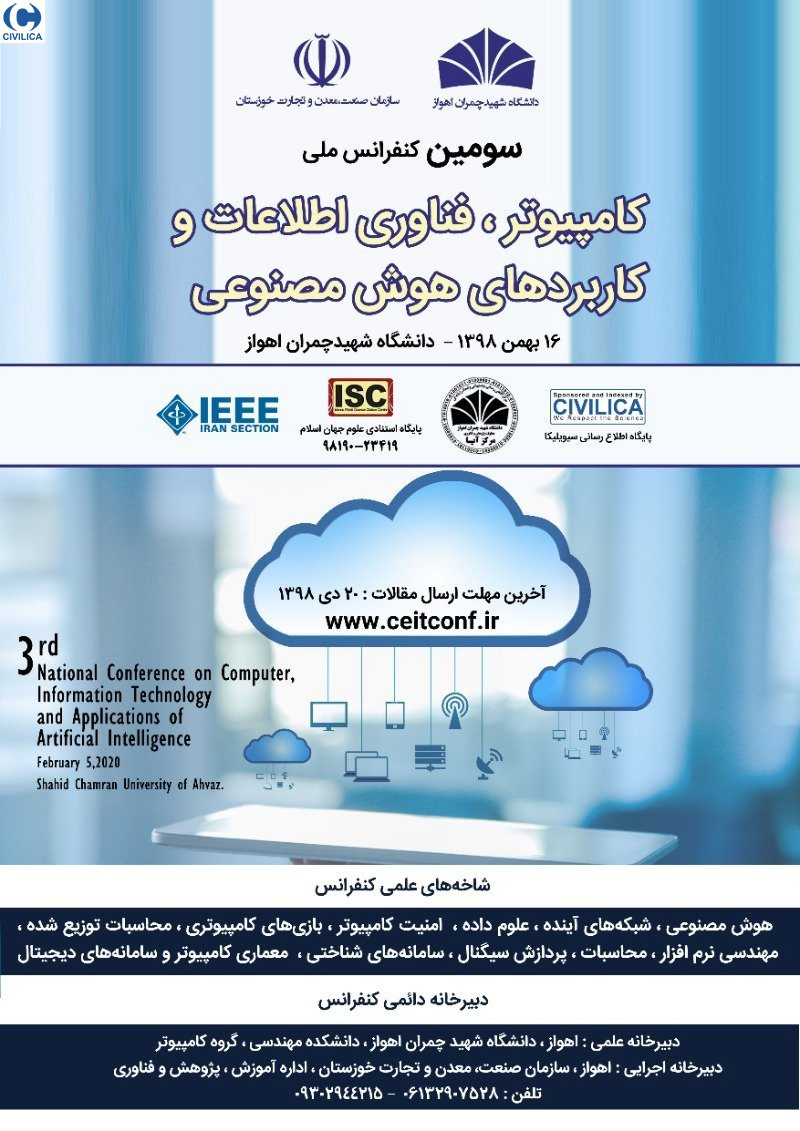 مجموعه مقالات سومین کنفرانس ملی کامپیوتر، فناوری اطلاعات و کاربردهای هوش مصنوعی16 بهمن 1398 · اهواز