
چکیده مقاله
Purpose:This paper explores how artificial intelligence AI and data capital can enhance environmental governance and green productivity in high tech industries The research addresses a key gap in current environmental economics: while the efficiency gains of AI are well recognized, their integration into governance systems remains under theorized—particularly in developing country contexts such as Iran By treating data infrastructures and AI capabilities as forms of intangible capital, the study redefines their economic role from technological tools to productive assets that can reduce environmental monitoring costs and improve regulatory precision Methods:The study adopts a conceptual–analytical methodology that synthesizes three theoretical strands: 1 the economics of intangible and data capital based on the CHS framework; 2 AI applications in environmental monitoring and policy support; and 3 environmental governance and policy efficiency theory Through a structured literature review and causal mapping, the research develops a unified conceptual framework explaining how AI investment and data capital accumulation can strengthen governance efficiency and lead to cost effective green outcomes Results:The conceptual analysis indicates that AI and data capital improve monitoring accuracy, predictive policy capacity, and enforcement efficiency, potentially increasing green productivity by 5–15% across high tech sectors Comparative evidence from ICT, renewable energy, and advanced manufacturing demonstrates that targeted AI adoption can lower compliance costs and environmental risks while enhancing data driven decision making Iran’s emerging digital infrastructure and high tech industrial base show significant potential for implementing predictive and cost efficient green policies Conclusion:Positioning AI and data capital as economic assets can transform environmental governance by creating a feedback driven system of monitoring and enforcement For Iran and similar economies, success will depend on strengthening digital infrastructure, data governance, and institutional capacity The proposed framework provides a foundation for future empirical research using productivity decomposition and panel data analysis to measure AI’s contribution to green productivity
کلیدواژهها
نویسندگان

Forough Esmaeily Sadrabadi
Assistant Professor of Economics, Department of Economics, Faculty of Humanities & Social Sciences, Ardakan University, Ardakan, Iran
Samaneh Talei Ardakani
Department of Economics, Faculty of Humanities & Social Sciences, Ardakan University, Ardakan, Iran
شیوه ارجاع
Esmaeily Sadrabadi, Forough and Talei Ardakani, Samaneh,1404,Data Capital and Artificial Intelligence for Environmental Governance: Towards Predictive and Cost-Efficient Green Policies in High-Tech Industries,The 3rd National Conference on Environmental Challenges: The role of industry, mining, and society in developing green governance,Tehran
ارائهشده در
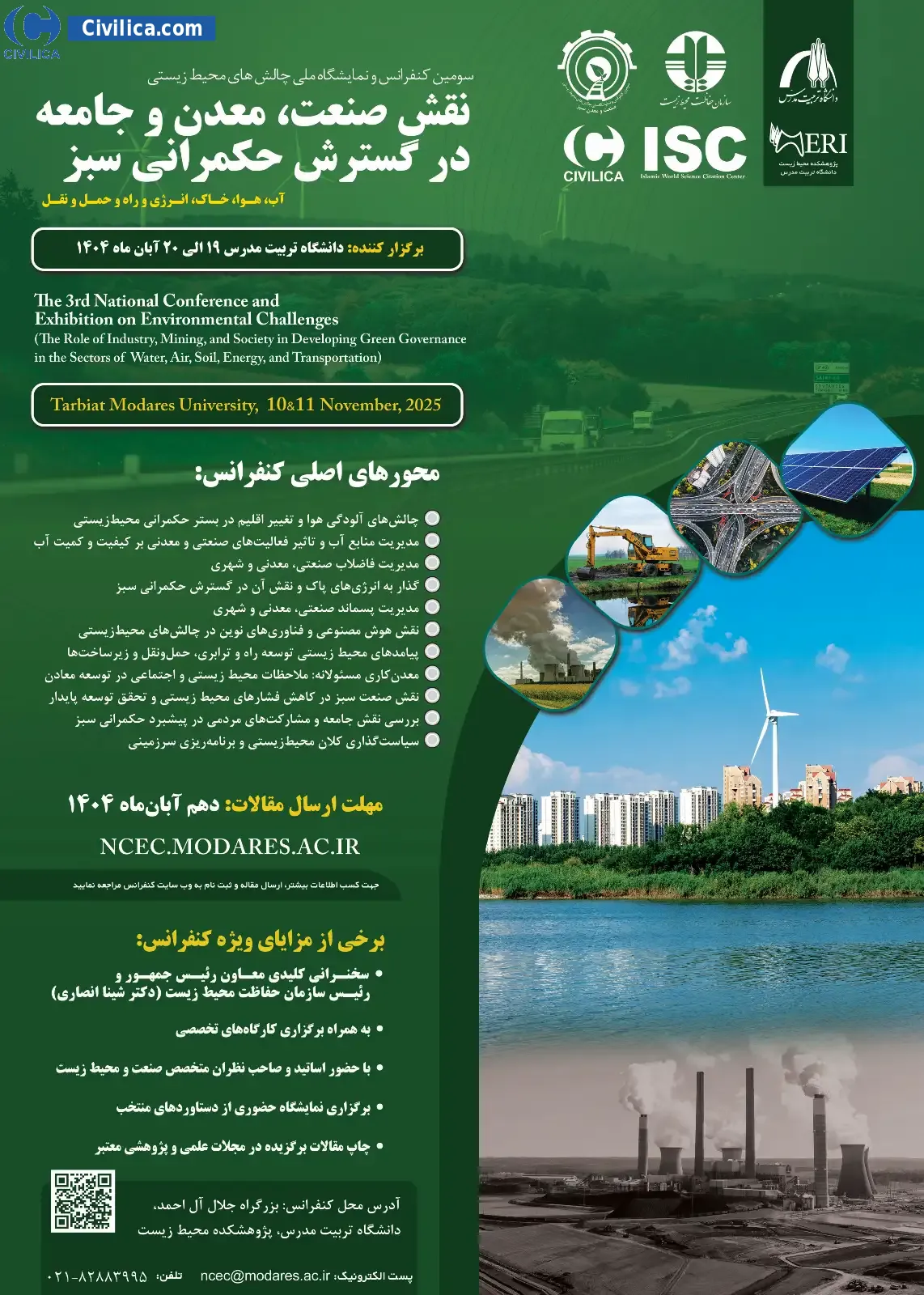 مجموعه مقالات سومین کنفرانس و نمایشگاه ملی چالش های محیط زیستی: نقش صنعت، معدن و جامعه در گسترش حکمرانی سبز19 آبان 1404 · تهران