
چکیده مقاله
Climate justice has emerged as a critical legal and moral issue, focusing on the disproportionate impact of climate change on marginalized communities This article explores the legal dimensions of climate justice, emphasizing the intersection between environmental inequality and socioeconomic impacts Vulnerable populations, often the least responsible for environmental harm, are disproportionately affected by the consequences of climate change, including extreme weather events, displacement, and economic instability Through an analysis of international law, national legal frameworks, and advocacy movements, this article examines the evolution of climate justice as a legal concept and the role of advocacy in addressing environmental inequality It critiques the limitations of current legal mechanisms, such as the Paris Agreement, and emphasizes the need for stronger legal obligations and enforcement mechanisms to ensure climate justice for affected communities The article concludes by proposing a multi dimensional approach that includes enhanced legal frameworks, increased international cooperation, and more robust grassroots advocacy efforts to address the socioeconomic impacts of climate change
کلیدواژهها
نویسندگان

Sayed Hojjat Faraji
Master of Human Rights, Shahid Beheshti University, Tehran, Iran
Sayed Mehrab Masoomi
Master of Human Rights, Shahid Beheshti University, Tehran, Iran
شیوه ارجاع
Faraji, Sayed Hojjat and Masoomi, Sayed Mehrab,1403,Promoting Climate Justice: Tackling Environmental Inequity and its Social and Economic Consequences,The 7th international conference on jurisprudence, law, advocacy and social sciences in the horizon of Iran 1404,Mashhad
ارائهشده در
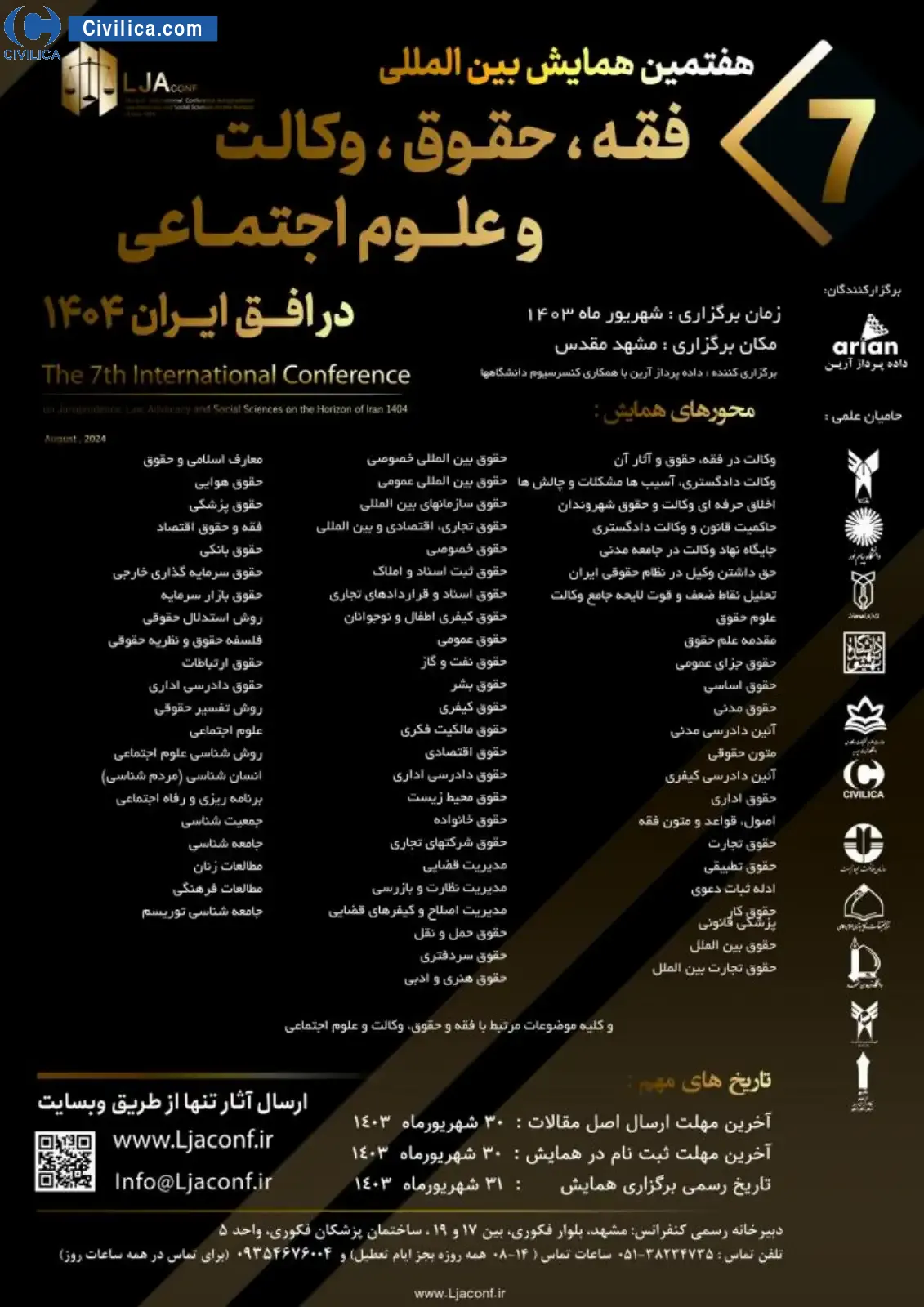 مجموعه مقالات هفتمین کنفرانس بین المللی فقه، حقوق، وکالت و علوم اجتماعی در افق ایران ۱۴۰۴31 شهریور 1403 · مشهد