
چکیده مقاله
Rapid advancements in the field of artificial intelligence have brought about significant transformations in educational systems The present study aims to examine and conceptualize the role of artificial intelligence in enhancing the quality of student learning and improving the effectiveness of teachers’ instruction in modern educational environments This research is qualitative in nature and was conducted using a descriptive–analytical approach The research data were collected through documentary review and analysis of credible national and international scholarly sources in the fields of artificial intelligence and education, and were examined using conceptual analysis The findings indicate that artificial intelligence–based technologies, by enabling personalized learning, providing immediate feedback, analyzing educational data, and supporting teachers’ instructional decision making, can increase students’ academic engagement and improve teaching effectiveness Moreover, the use of AI tools can automate some of teachers’ repetitive tasks, thereby allowing them to devote more time to deeper instructional activities and meaningful learning interactions The purposeful integration of artificial intelligence into educational systems can lead to improved learning quality, increased student academic motivation, and a transformation of the teacher’s role from a transmitter of knowledge to a facilitator of learning Nevertheless, effective utilization of this technology requires the development of teachers’ digital literacy, the establishment of ethical frameworks for the use of educational data, and the provision of appropriate infrastructure within educational systems
کلیدواژهها
نویسندگان

Hossein Zafari Davazdah Emami
نویسنده اول
Hassan Zafari Davazdah Emami
نویسنده دوم
شیوه ارجاع
Zafari Davazdah Emami, Hossein and , Hassan Zafari Davazdah Emami,1404,Analyzing the Role of Artificial Intelligence in Enhancing Student Learning and Improving the Effectiveness of Teachers’ Instruction: A Conceptual Approach to Smart Education,The Third International Conference on Smart Technologies in the Field of Educational Sciences, Psychology, Counseling, and Philosophy
ارائهشده در
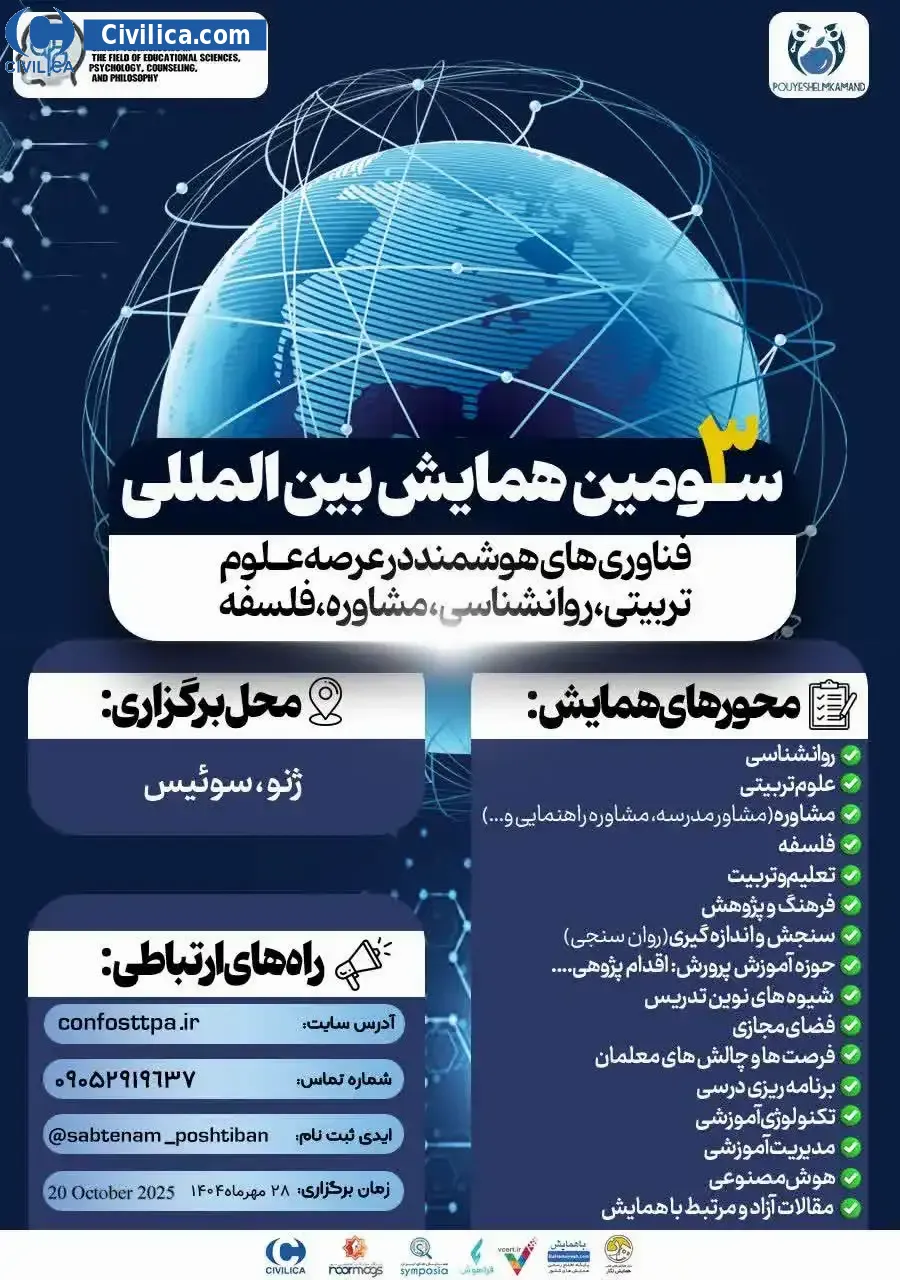 مجموعه مقالات سومین همایش بین المللی فناوری های هوشمند در عرصه علوم تربیتی، روانشناسی، مشاوره ، فلسفه28 مهر 1404