
چکیده مقاله
This review explores vehicle crash box technologies, with particular consideration of their application in electric vehicles EVs , classified into metallic, composite, and bio inspired designs Metallic absorbers, such as steel and aluminum thin walled crash boxes, and multi cell structures are cost effective, manufacturable, and predictably deformable, but their high density increases vehicle mass, reducing efficiency in electric and hybrid vehicles EVs and HEVs can be counted as their downsides Composite absorbers, including CFRP, GFRP, and foam filled structures, provide significantly higher specific energy absorption SEA and weight reduction, making them suitable for lightweight designs, though challenges remain in manufacturing complexity, cost and recyclability Hybrid and bio inspired crash boxes integrate complex geometries and multi material systems to maximize energy absorption Bio inspired designs are further categorized as plant, animal, and microstructure inspired Plant inspired structures, modeled after bamboo, lotus root, and honeycomb, achieve SEA gains exceeding 90% via hierarchical and multi cell arrangements Animal inspired designs, such as ladybeetle, shell derived geometries and sea sponge lattices, improve buckling control and maintain stable plateau stresses Microstructure inspired designs, including fractal branching and auxetic geometries, offer tunable deformation and multi plateau stress strain responses Advances in additive manufacturing AM , numerical optimization, and material engineering enable these designs to deliver high energy absorption while minimizing weight, highlighting their potential for protecting battery packs in EVs and HEVs
کلیدواژهها
نویسندگان

Amirreza Ajorlou
Automotive Fluids and Structures Analysis Research Laboratory, School of Automotive Engineering, Iran University of Science and Technology, Tehran, Iran
Hamed Saeidi Googarchin
Automotive Fluids and Structures Analysis Research Laboratory, School of Automotive Engineering, Iran University of Science and Technology, Tehran, Iran
شیوه ارجاع
Ajorlou, Amirreza and Saeidi Googarchin, Hamed,1404,Lightweight Energy Absorbers for Electric Vehicles: Review and perspectives,2nd International Conference on Modern Power Trains,Tehran
ارائهشده در
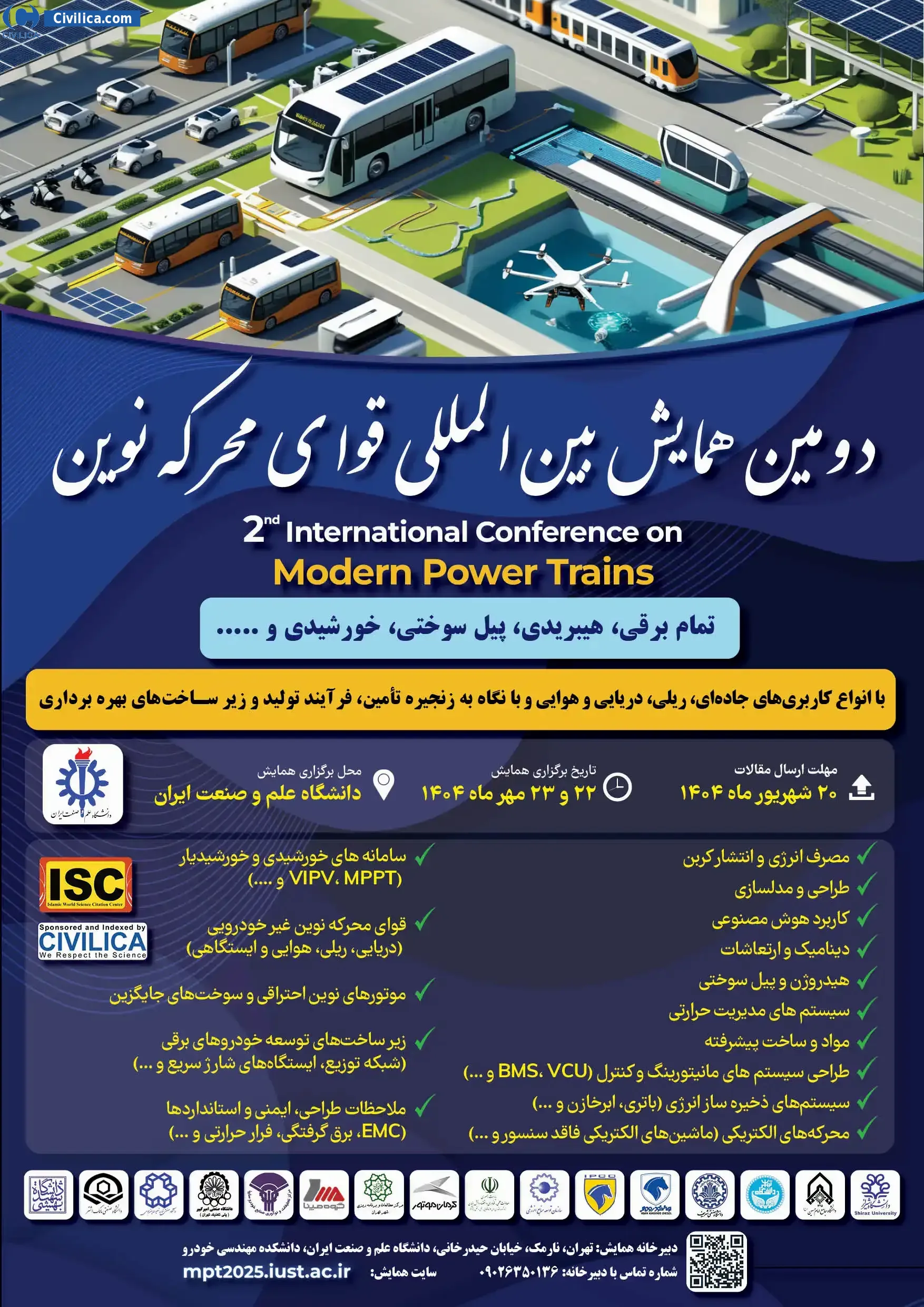 مجموعه مقالات دومین همایش بین المللی قوای محرکه نوین22 مهر 1404 · تهران