
چکیده مقاله
The emigration of engineering graduates—commonly framed as 'brain drain'—poses a sustained threat to the innovation capacity and industrial upgrading of sending countries While scholarship has examined employability, curriculum reform, and university–industry partnerships UIPs , the explicit role of structured UIPs as mechanisms for reducing migration intentions remains under theorized This paper develops a multi theoretical, policy oriented conceptual framework that specifies how concrete UIP mechanisms curriculum co design, structured internships and co op placements, applied capstone projects, sustained mentorship, and university industry entrepreneurial ecosystems operate through mediators skill alignment, employability, professional identity, and embeddedness and social capital to reduce the propensity of engineering graduates to emigrate Integrating push–pull dynamics with human capital, social capital, embeddedness, and career construction theories, we articulate five testable propositions, link each proposition to specific pedagogical innovations and operational indicators, and propose an empirical agenda tracer surveys, structural equation models, and quasi experimental evaluations The contribution is both theoretical—by synthesizing complementary lenses into a cohesive causal model—and practical—by offering measurable policy levers and actionable institutional KPIs for universities, industrial partners, and policymakers
کلیدواژهها
نویسندگان

Asadollah Kalantarian
Center for Engineering Education, Sharif University of Technology, Tehran, Iran
Alireza Jahantigh Pak
Center for Engineering Education, Sharif University of Technology, Tehran, Iran
شیوه ارجاع
Kalantarian, Asadollah and Jahantigh Pak, Alireza,1404,Bridging Engineering Education and Industry to Mitigate Graduate Migration: A Multi-Theoretical Conceptual Framework,9th Iran International Conference on Engineering Education,Arak
ارائهشده در
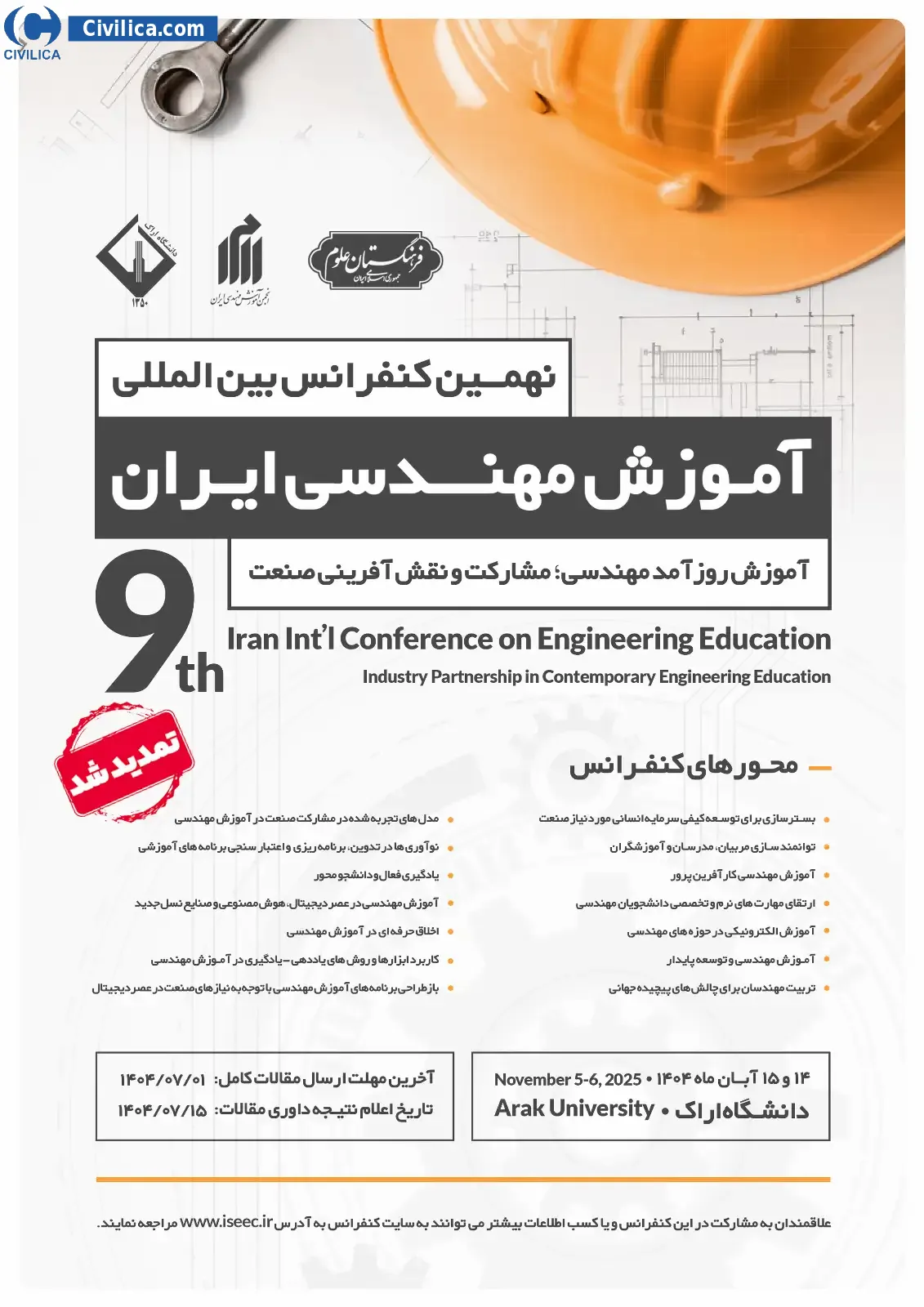 مجموعه مقالات نهمین کنفرانس بین المللی آموزش مهندسی ایران14 آبان 1404 · اراک